

When Should You Take Social Security? Comparing Benefits at 62, 67, and 70
Deciding when to take Social Security is an important part of retirement planning. You can begin receiving benefits as early as age 62, wait until your full retirement age, or delay until age 70. Each option comes with tradeoffs, and the right choice depends on your financial situation, health, retirement goals and other sources of income.
What Happens If You Take Social Security at 62
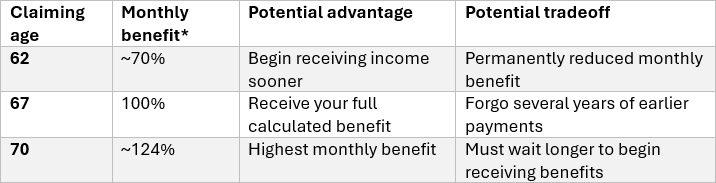
Age 62 is the earliest you can begin receiving Social Security retirement benefits. Receiving income sooner can be appealing if you've already retired, need additional cash flow or have health or longevity concerns.
The tradeoff is a permanently reduced monthly benefit. For someone whose full retirement age is 67, claiming at 62 can reduce their monthly benefit by as much as 30%.
Waiting Until Full Retirement Age
For anyone born in 1960 or later, full retirement age (FRA) is 67. Waiting until FRA allows you to receive 100% of your calculated retirement benefit without the reduction associated with claiming early.
FRA is also important if you plan to continue working. Before reaching it, Social Security benefits may be temporarily withheld if your earnings exceed certain limits. Once you reach full retirement age, those earnings limits no longer apply.
Delaying Social Security Until 70
If you don't need Social Security immediately, delaying beyond full retirement age can increase your monthly benefit through delayed retirement credits. For someone with an FRA of 67, waiting until 70 can increase the monthly benefit to approximately 124% of the full retirement benefit.
A larger monthly benefit may be particularly valuable for those who live well into retirement. It can also be an important consideration for married couples when planning for potential survivor income. Benefits stop increasing at age 70, so there is generally no advantage to waiting beyond that point.
What Should You Consider Before Deciding?
There isn't one "best" age to take Social Security. Before making your decision, consider:
- Your health and life expectancy: A longer retirement may make delaying benefits more valuable.
- Your income needs: Do you need Social Security now, or can other assets provide income while you wait?
- Your work plans: Continuing to work may affect benefits and include penalties if you claim before full retirement age.
- Your spouse's benefits: Claiming decisions can affect household income and potential survivor benefits.
- Your investments and taxes: Consider how Social Security works alongside retirement accounts, investments and other income sources.
What California Retirees Should Know
For those planning for retirement in California, there is another important factor to consider: California does not tax Social Security benefits at the state level, although some benefits may still be subject to federal income tax depending on your overall income.
Other retirement income, including IRA and 401(k) withdrawals, pensions and investment income, may be treated differently for California tax purposes. This makes it important to consider not only when you claim Social Security, but also how your benefits coordinate with withdrawals from retirement accounts, investments and your broader tax strategy.
Make Social Security Part of Your Bigger Retirement Plan
Choosing whether to take Social Security at 62, 67 or 70 is just one piece of the retirement planning puzzle. Your claiming strategy should be considered alongside your investments, taxes, spending needs, healthcare costs and other sources of retirement income.
A comprehensive financial plan can bring these pieces together, helping you understand where you stand today and what steps you can take to stay on track toward the retirement you envision.
Not sure when Social Security fits into your retirement plan? At Summit Financial Group, we help individuals and families develop personalized financial plans designed around their goals, priorities and vision for retirement. Whether retirement is approaching or still years away, our team can help you build a plan for the road ahead. Contact us to learn how a comprehensive financial plan can help you prepare for the retirement you envision.
*This information is intended for educational purposes only and should not be considered individualized financial, tax or legal advice. Social Security rules and benefits are subject to change. Individual circumstances vary.
