

What drives gas price volatility and how it impacts US households
Geopolitical tensions and disruptions to global energy supply often lead to higher gas prices at the pump. Amid the current conflict in Iran, oil prices have surged to above $100 per barrel for the first time since 2022. Although the US is a net exporter of oil, Americans are not immune to rising global oil prices that push gasoline costs higher.
Oil is a global market, so when prices rise, they increase across the board, including in countries like the US that export more oil than they import. However, despite global market pressures, US drivers actually pay among the lowest gas prices at the pump. The reason has less to do with domestic oil production and more to do with fuel taxes.
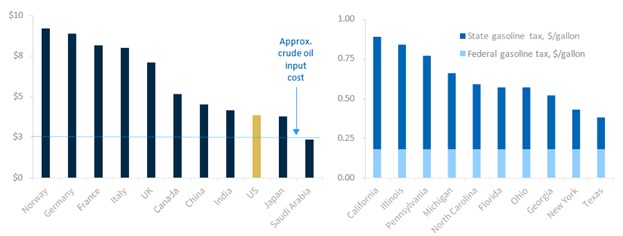
Source: AAA, GlobalPetrolPrices.com, Tax Foundation. Data as of 3/20/2026.
Europe has higher fuel taxes as governments prioritize energy conservation, which leads to higher electric vehicle market share and reduced overall auto ownership. By contrast, the US federal gasoline tax hasn’t increased since 1993. At the bottom end of the price spectrum are some of the Organization of the Petroleum Exporting Countries, where gasoline is sometimes priced below the input cost of crude. On the domestic front, gas prices can vary widely by state with differences driven by state‑level taxes.
Impact of gas prices on American consumers
There have been significant shifts in how reliant American consumers are on gasoline. For instance, gas prices currently account for only 1.7% of a typical household budget, an all-time low and less than half of its share three decades ago. This reflects improvements in fuel economy: A typical new light-duty vehicle gets 30 miles to the gallon, up from 20 miles per gallon three decades ago.
As shown in the table below, the cumulative impact of higher gasoline prices on a typical household wouldn’t reach $1,000 even if gasoline were to stay at $4 per gallon through the end of the year. That said, lower-income households are feeling the pinch given that they spend a higher share of income on fuel and other necessities. Higher income households, which account for a disproportionate share of consumer spending, are less sensitive to what happens at the pump.
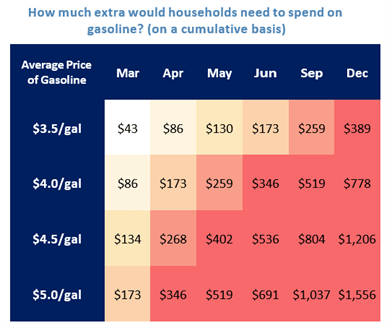
Source: Raymond James Investment Strategy. Data as of 3/20/2026.
Limited government options for easing gas prices pressures
Typically, during periods of geopolitical tensions or disrupted oil supply, the government has certain levers it can pull to partially ease prices at the pump, including a suspension of the state gasoline tax. While suspending gas taxes lowers prices for consumers in the short term, the action runs the risk of creating a hole in state budgets that will eventually need to be filled. Beyond tax policy, governments may also act to stabilize supply. Examples include the recent multinational release of crude oil from emergency stockpiles and temporary lifting of US sanctions on Russian and Iranian crude in response to disruptions caused by the Iran conflict.
At the federal level, the US Environmental Protection Agency (EPA) is set to suspend summertime blending requirements for gasoline. Under normal circumstances, fuel companies are required to change the gasoline formula during the summer driving season to reduce smog. The EPA’s authority to waive this rule has been used historically in cases of Gulf Coast refining disruptions after hurricanes. The resulting savings are typically $0.10 to $0.30 per gallon, varying based on regional fuel market dynamics.
The bottom line
Increased gas prices are an often unavoidable result of global energy disruptions, even for a country that produces more oil than it consumes. While higher prices can create near‑term pressure, gasoline today represents a much smaller share of overall US household spending than in past decades. Government actions can help soften price spikes, but options are limited.
All expressions of opinion are those of Investment Strategy and are subject to change. This information should not be construed as a recommendation. The foregoing content is subject to change at any time without notice. Content provided herein is for informational purposes only. There is no guarantee that these statements, opinions or forecasts provided herein will prove to be correct.
Past performance is not a guarantee of future results. Indices and peer groups are not available for direct investment. Any investor who attempts to mimic the performance of an index or peer group would incur fees and expenses that would reduce returns. No investment strategy can guarantee success. Economic and market conditions are subject to change. Investing involves risks including the possible loss of capital. The information has been obtained from sources considered to be reliable, but we do not guarantee that the foregoing material is accurate or complete.
Diversification and asset allocation do not ensure a profit or protect against a loss. Investing in oil involves special risks, including the potential adverse effects of state and federal regulation and may not be suitable for all investors.
