

Asking the more appropriate question
Doug Drabik discusses fixed income market conditions and offers insight for bond investors.
“Would I be better off waiting for the Fed to make its move on rates before investing?” “Should I wait to increase duration because a blocked Strait of Hormuz could push oil prices higher and push rates even higher?” “Should I invest in bonds gradually to reduce the risk of missing the rate peak?”
These are questions we hear on a regular basis and are reasonable questions. However, they may place too much emphasis on short-term rate forecasting and not enough emphasis on the purpose of the fixed income allocation.
Market timing is usually better suited to tactical investing, where the goal is to capture quick total return from price appreciation. That approach may be more appropriate for the growth-oriented side of a portfolio, where investors are already accepting higher volatility in pursuit of higher returns. Fixed income, by contrast, is often used more strategically: to provide income, reduce portfolio volatility, support principal preservation, and create more predictable cash flows.
For that reason, the key question is not always, “Can I invest at the exact peak in rates?” A more practical question is, “Can I lock in a suitable income stream from high-quality bonds that supports my long-term plan?”
Interest rate cycles can be long, and identifying the peak in real time may be more a matter of chance than precision. Investors are limited by the rate environment available when they put money to work. When an investor is ready to invest, it may be dictated by uncontrollable circumstances as well as their stage in life. As the chart illustrates, from 2005 through 2020, the 10-year Treasury averaged approximately 2.85%. Over the last three years, it has averaged approximately 4.24%. That difference matters. In lower-rate environments, investors often reach for additional risk to generate income, which can work against the role fixed income is intended to play in a portfolio.
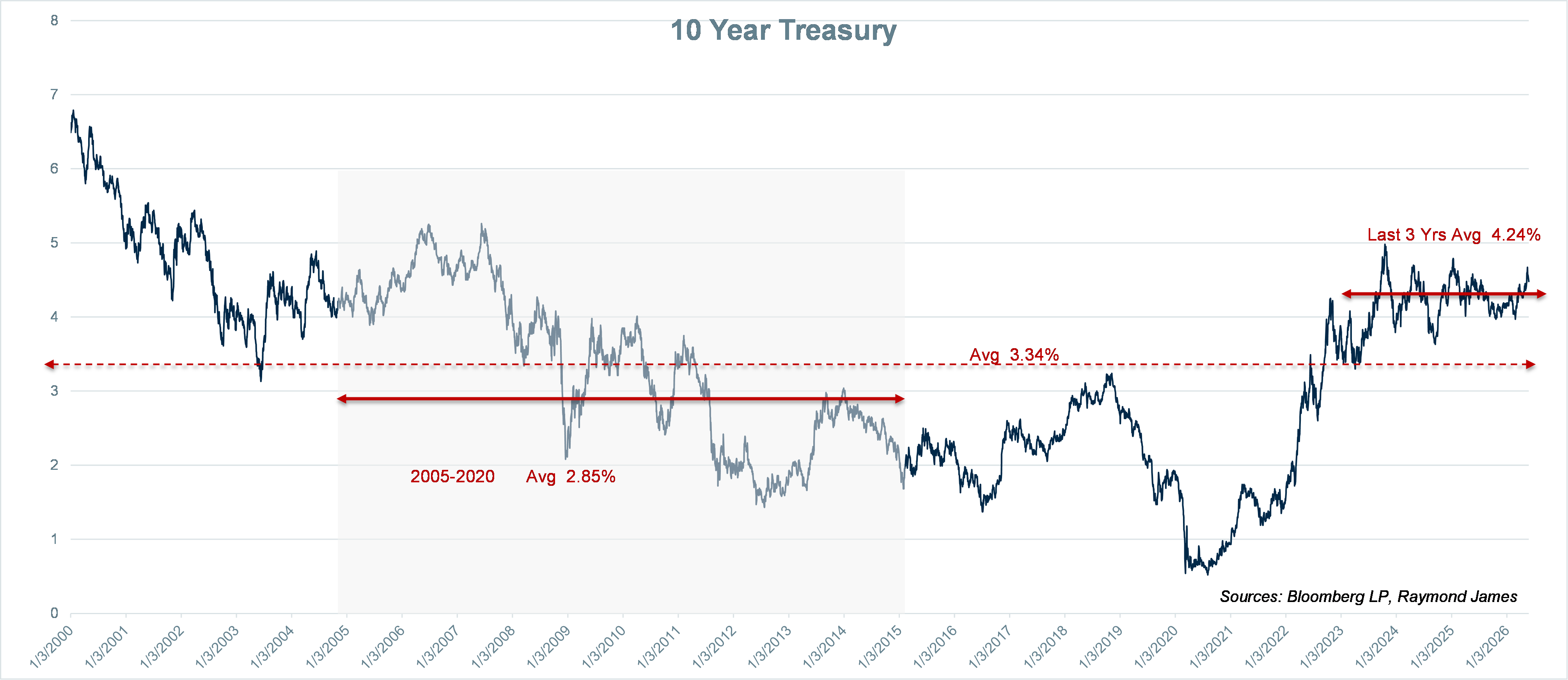
Today’s higher-rate environment gives investors a more attractive opportunity. High-quality individual bonds can help preserve capital when held to maturity, while also providing meaningful income. Extending duration, or locking in longer maturities, may allow investors to secure income streams that were not available for much of the prior decade.
That does not mean every dollar must be invested at once. For investors concerned about the possibility of rates moving higher in the near term, a staged approach or bond ladder may be appropriate. This can reduce the pressure of trying to pick the exact rate peak while still allowing the investor to begin capturing today’s elevated yields.
Geopolitical events, inflation concerns, Fed policy, and oil prices can all influence rates in the short term. But fixed income strategy is typically a long-term planning decision, not a reaction to every near-term headline. Rate peaks are only obvious after the fact. For many investors, the greater risk may be waiting too long for a perfect entry point and missing the opportunity to lock in income levels that already support their long-term objectives. This brings us back to perhaps the more appropriate question, “can I lock in a suitable income stream from high-quality bonds that supports my long-term plan?”
The author of this material is a Trader in the Fixed Income Department of Raymond James & Associates (RJA), and is not an Analyst. Any opinions expressed may differ from opinions expressed by other departments of RJA, including our Equity Research Department, and are subject to change without notice. The data and information contained herein was obtained from sources considered to be reliable, but RJA does not guarantee its accuracy and/or completeness. Neither the information nor any opinions expressed constitute a solicitation for the purchase or sale of any security referred to herein. This material may include analysis of sectors, securities and/or derivatives that RJA may have positions, long or short, held proprietarily. RJA or its affiliates may execute transactions which may not be consistent with the report’s conclusions. RJA may also have performed investment banking services for the issuers of such securities. Investors should discuss the risks inherent in bonds with their Raymond James Financial Advisor. Risks include, but are not limited to, changes in interest rates, liquidity, credit quality, volatility, and duration. Past performance is no assurance of future results.
Investment products are: not deposits, not FDIC/NCUA insured, not insured by any government agency, not bank guaranteed, subject to risk and may lose value.
To learn more about the risks and rewards of investing in fixed income, access the Financial Industry Regulatory Authority’s website at finra.org/investors/learn-to-invest/types-investments/bonds and the Municipal Securities Rulemaking Board’s (MSRB) Electronic Municipal Market Access System (EMMA) at emma.msrb.org.
